Monday, October 29, 2012

That Time I Got Robbed


The world is not a safe place – that much has been obvious to me ever since the day my mother and her impromptu neighborhood watch group discovered that our local bike thief was in cahoots with our ice cream lady.  It turns out that she didn’t have only ice cream sandwiches in the back of her trunk, but a delinquient son scoping out our sweet ten-speeds. Also, her garage was full of torn apart bikes, like a sad childhood graveyard.  That experience taught me to lock up my shit.  It also led me to do things like wear money belts, even when it leads people to assume I’m wearing a diaper, and occasionally sprint for blocks at a time in heels, just to keep my reflexes sharp.  I’m a safe girl.  I like safety.

Dramatic representation of my ice cream lady circa 1993

But as we all know, sometimes precautions and awareness aren’t enough.   Before coming to Senegal, I (safely and cautiously) looked over some crime statistics.  In some ways, they were striking, but once I compared them the rates of where I was living at the time (Logan Square), I relaxed a little bit.  On paper, Logan Square seemed pretty dangerous.  In reality, I left my car unlocked on the street for 9 months without a problem.  So you never know.

Now, after living in Senegal for about 19 months, I can admit to having seen my fair share of crime.  I would guess that almost all of my friends have experienced some sort of petty theft, purse snatching, pickpocketing, or phone hijacking by this point: though luckily, these are incidents that pass relatively harmlessly and silently, save for the incurred losses.  But I’ve also had a handful of friends deal with far more serious and violent situations.  As time went on, it became to seem more and more improbable that I could leave this country without a blemish on my security record.  Paranoia and money belts can only get us so far, or as Fiona Apple would say, the world is full of pits and crevices that will try to kill you.  Plus, especially in places like Dakar, I admit that my fancy hoop earrings from Claire’s and wedge sandals bought on the side of the road make me some sort of walking target.  The question became not if, but when, someone would try to pull one over on me.

September 14 was the night of reckoning.

I had just finished our Girls’ Camp.  I was flying high!  It had been an exhausting week, but I came to Dakar to recuperate for a few days and see some friends off to America.  After eating an entire pizza by myself, I headed downtown to meet some other volunteers with my friends Aimee and Kirstin.  We had a wonderful taxi ride.  In fact, it was so wonderful that when we arrived at our destination in downtown Dakar, I said as I unzipped my clutch, “Wow guys, that was just SUCH a great cab ride!”

At that moment, a hand reached in through the taxi window and snatched my clutch out of my hands.  Oh no!  My money!  My bank card!  My phone!  My chapstick!  Best cab ride ever RUINED!

OR WAS IT???

The answer, my friends, lies in a reaction I did not expect out of myself, though I must admit that in my elaborate crime anticipation scenarios, I always vowed to use the last remnants of fast-twitch muscle fibers that cross country had not destroyed to chase down an assalient.  I mean, you might as well, right?  Especially if you’re in a public place?  It’s worth a shot?  I think that’s where my head was.

So the next thing my friends knew, I was rolling around on the ground outside the cab yelling expletives BECAUSE I HAD DECIDED TO JUMP OUT THE CAB WINDOW and chase down the thief.  Was I sitting next to a door?  Yes.  Do I understand how door handles work?  Yes.  And yet... the window beckoned me.  The route to which my clutch had been lost beckoned me.  So I followed the clutch, through the open window, onto the street, and began running in the general direction of the purse-snatcher, screaming “SACCKAAT SACCKAAT SACCKAAT!” which is the Wolof word for thief.  Because WE WILL NOT GO QUIETLY INTO THE NIGHT.


The inspiration for every moment of my life

Help arrived quickly and efficiently.  Brave and courageous Peace Corps volunteers jumped over fences, through shrubbery, and around gates to come to my aid: truly, a league of extraordinary gentlemen. The United States Marine Corps also came to my assistance.  But most importantly, about 25 loitering Senegalese men took on my cause, formed an angry mob, and set out to hunt down the man who took my beloved possessions.

But despite the group’s enthusiasm, it seemed like the culprit had escaped unscathed, probably during the moments I lost peeling myself from the pavement after rashly jumping out a window.  And so I gave up and gave in to Senegal, conceding defeat after an exhausting week of work and reporting my possessions (on another phone) as stolen. 

But then!  The mob returned, a scared man in a Senegalese soccer jersey in tow!  “Was this the man who stole your purse?” the mob cried, thrusting him toward me.  I didn’t want to respond because it had all happened so fast: he seemed to be wearing the right shirt, but I also had no idea what punishment awaited this man.  What if I sent an innocent man to Senegalese jail?  I tried to avoid categorically saying yes, instead saying, “I... think so?”  But everyone was sure, “This was the man, he is a known thief, this is the man, this is not the first time!”  As one impassioned volunteer chased after the mob yelling, “Bring him to justice!  WE MUST BRING HIM TO JUSTICE!”, I trailed after crying, “Wait!  Wait!  Pardon him!  He is pardoned by the goodness of the rest of you!  He is pardoned by the goodness of his countrymen!”  No one listened.  Also, no one would give me my wallet.  It took a few blocks of marching until I realized that the accused didn’t even HAVE my wallet.  This did not feel like justice to me.

Meanwhile, near the original scene of the crime, my cab mate Aimee was still combing the area like a good CSI agent.  Suddenly, she was approached by a kind gentleman: “Floran?  Are you Floran?”  Immediately realizing the significance of this coincidence, she took on my identity, rejoicing, “Yes!  That is me!”  The kind man extended his hand, which held my wallet.  “This was thrown at me about 15 minutes ago,” he said, handing it over to her.  “I think it’s yours.”  And indeed, so Aimee, using her Sereer language skills, recovered my wallet, money, bank card, cell phone, chapstick and all.  How the kind gentleman somehow missed connecting a fleeing man chucking a wallet at him, an angry mob passing his guard post numerous times, and a depressed, teary American girl moping by is beyond me, but he did.  But in the end, he did manage to maneuver the wallet back into my possession, and for that, I am extremely grateful.

Aimee has been elevated from gum shoe to detective (skipping the rookie phase)


I’m not sure what happened to the thief – after trying to pardon him and failing, I gave up and returned to our original destination.  I bought a beer for Aimee and a kebab for the bar bouncer who apparently hunted down the thief, and then we all went dancing.  I literally stuck my purse down my pants for the entire night, without shame, as a way of dealing with my stage 1 PTSD.

Ultimately, I felt pretty lucky that my first, and hopefully last, brush with Senegalese crime was so tame, and moreover, had a happy ending.  Sure, there was the bad seed who stole my purse, but so many good seeds had come to my aid and defended my honor.  I still like to believe this is how the world works  – not only in Senegal, but everywhere.  Seeing it in action was quite a wonderful way to end what had been a crazy, topsy-turvy week.  

So cheers to everyone who helped me out of that sticky situation, to everyone who had to listen to me retell it numerous times in the style of Tai from Clueless, and to Senegal, for always pulling through when I least expect it. 


Monday, September 24, 2012

Girls Camp 2012!


And with that, Thies Girls Camp 2012 is complete!  After a wonderful week of talking about nutrition and reproduction and the environment and gardening and possible careers and business and marketing and everything in between, camp came to a tearful close a few Fridays ago.  And yes, when I say tearful, that is what I mean.  The girls started thinking about departure a full 24 hours before it actually happened, which added a flair of drama to Thursday night’s talent show.  One moment, everyone was dancing to Rihanna and having the time of their lives!  In the next moment, Beyonce’s Halo had reduced all of the girls to blubbering messes as they clutched their new friends in a swaying dance circle.  Lesson?  You can put a girl in a week-long camp and help her escape a week’s worth of housework… but she can never escape her teenage hormones.  In the best way!

Kathleen, Rita, and I pose with Aissatou, one of our counselors, and my some of my Thies girls on the last day of camp.

No, but truly, camp was wonderful.  All of my fellow PCVs did a fantastic job with the sessions they’d prepared, forcing the girls into three-legged races, teaching them about dental hygiene, showing them the beauty of the environment, and awakening their quiet entrepreneurial spirits.  All of our Senegalese counterparts did a phenomenal job as well, inspiring the girls to try eggs instead of just chocolate for breakfast, clarifying mystifying concepts like the power of the moringa plant, and giving them honest, and thoughtful advice.  And the girls?  The girls were amazing: they jumped right into the spirit of camp from day 1, participating in every session, asking questions, taking notes, making fantastical artistic creations, never complaining, and as it appeared to me, never sleeping.  By the end of camp, they were all resolved to start their own clubs in order to teach other people what they’d learned, keep in touch, and maybe even take field trips to the other cities.  Win!

Somehow, I was put in charge of explaining the idea of dreamcatchers to the girls.  It went something like this: "You hang this net over your bed and nightmares get caught like fish and good dreams pass through!  It is a traditional object from the first Americans who lived among the environment!  Put yarn to kill nightmares!"  


Hard at work making moringa porridge for tomorrow's breakfast.  

Rita and Chelsea use our beautiful training center to show examples of plants and live fencing.

The girls painted tires to use as recycled plant containers.  My host sister Fatimata is in the neon!

Out of all the sessions, I think the one that really came to define camp, at least for me, was the presentation given by our gender and development advisor, Awa Traore.  I’ll give you a little snapshot of it (with words, because no one had a camera during this session):

Before Awa came, the girls watched a Peace Corps-produced movie following five working women in Senegal, Awa included.  Each of the women told her personal story, paying special attention to the challenges she’d faced over the course of her life.  The women talked about balancing work, family, and tradition, especially emphasizing the important and irrefutable role that Senegalese women play in society.  Then, at the end, they challenged the girls to continue their educations and find a way to improve life in Senegal.  I led a brief reflection after the movie, mostly quizzing the girls to see if they’d paid attention.  They had.  In fact, a few nights later my host sister called me into the living room to point excitedly at the news, where one of the film’s women was being interviewed on TV. 

But what made an even bigger impact was the appearance of Awa herself after the film, a living and breathing version of the figure they’d just watched on-screen.  Awa worked the crowd like nothing I’d ever seen.  In one instant, she riled them up with an improvised skit about how boys flirt in Senegal --  only to bring the girls to a hush moments later by asking them soul-jarring questions.  She found a way to make the room’s atmosphere both completely safe, completely honest, and completely empowering. 

The first point she talked about was ROMANCE, which obviously hooked the girls from the get-go.  In addition to that reenactment of flirting, she also talked about the difference between provocation and confidence.  Then, in one of my favorite moments of camp, she said, “Having a boyfriend isn’t a problem!” (dramatic pause)  “But when DOES a boyfriend become a problem?”, which led to shouts of “When he takes time from your studies!” “When he asks you for money!” and “When he gets you pregnant!”  From there, Awa segued into a frank discussion about sexual violence, incest, and the rape, but did it all with the effervescence of a sage.  The girls rose to the occasion, gravely absorbing each word with wide eyes and nodding heads.

Next, Awa asked the girls about their future plans.  Hands shot up.  “Doctor!” “Lawyer!” “Diplomat!” “Engineer!”  -- all of them had a chance to share with her exactly how they saw themselves.  Then she asked all of the girls to close their eyes and imagine a scene 10-15 years from now.  Where were they?  What were they doing?  Who were they with?  After a few moments, she asked a few girls to share, and I loved their answers:
  •   “I was with my husband.  We were both studying in a library in America to be lawyers.  I was sending money that I earned there to help my family here.”
  • “I was in Greece on a beautiful beach, living in a beautiful house with my family.  I had my degree on the wall.”
  • “I was in my clinic that I owned as a doctor, in Senegal.  After work, I go home to my sincere, honest, faithful husband and our two children.”

After many girls had shared, Awa then asked, what would happen if you got pregnant right now?  What would happen if you stopped going to school right now?  Would these dreams still be possible?  The girls thought about what she said, and she then ended it with my favorite bit of advice:


“You all need to take responsibility, right now, for your choices.  Whatever those choices may be – you must deal with the consequences.  The consequences may be good or they may be bad.  But either way, you have a responsibility to yourself and your dreams to face them head on.  And you must decide how you will go forward.”


And to me, that kind of became my overarching theme for camp – not only that bit of advice, but Awa’s whole presentation: I wanted the girls to see how all of their choices do factor into their lives.  I wanted them to understand that they do have choices, even if that choice is only in how they react or voice their opinions.  And I wanted them to remember how capable Awa had made them feeI.  If they took anything from camp, I hope it was from this session.  And from the way I heard them continue talking about it, they did.

There were other amazing moments from camp, inevitably.  I’ll never forget the high-pitched squealing that accompanied each chastely romanctic scene from Bend It Like Beckham (such a good choice for Senegalese city girls!  The story about balancing the desire to be a soccer star with the disapproval of your highly traditional family resonated so well! Plus, they loved the Indian dance scenes, clothes, and really identified with the overly dramatic matriarchal figures!).  Throughout the week, I also adapted Valparaiso football cheers to various directions and moments.  A big favorite was the "Ooga ooga" chant, which we used to do things like "go to the back room" and "get ready for lunch."  I’ll also never forget how our talent show somehow became a comedic roast of me.  It’s not just at American camps that the camp director becomes the comic relief and buffoon!  I would have been offended if they hadn’t also done such great skits about how to not die from malaria or get knocked up.  Also, they kept serving me tea.


So, in essence, thank all of you for supporting me and my neighbors with this project!  It turned out far better than I expected, and I couldn’t have survived the process with so much encouragement from back home!  I’m excited to keep in touch not only with my girls over the next few months, but also a lot of the Senegalese counterparts who stopped by too.  Just yesterday, I stopped by the school to pay the registration fees for my scholarship winners.  So begins another year!  And so concludes this chapter of Thies Girls Camp: edition 2012.  All my love!

Campers, volunteers, and counselors, 2012 :)

And, for the blog cliffhanger, prepare yourselves for future entries about my recent brush with attempted robbery and a critical analysis of dancing in Senegal.  COMING SOON!

Thursday, September 6, 2012

Guys Love Girls with (Life) Skills (and vice-versa)


You may have noticed that I occasionally allude to a mysterious “Life Skills/NGO/Plan project” ... without ever really delving into what it is.  WELL.  Get excited everyone, because by reading this entry, you have unwittingly bought a ticket to the LIFE SKILLS EXPRESS.  And this train... no, I don’t want to use metaphors.  I’ll just try to give you the lowdown on what I’ve been up to.  But yes – the secret of Lisa’s Loch Ness monster will be no more!  Saskwatch will be revealed, and you will feel the wonder of Laura Dern when she realizes that it’s not just an island... IT’S AN ISLAND OF DINOSAURS!  Anyway:

So Plan, formally Plan International, is an NGO with a primary focus on children’s rights: the right to live in healthy environments, the right to economic security, the right to education, the right to citizenship, among others.  In Senegal, most of Plan’s work centers on the adoption of communities and the creation of advisory councils encompassing all ages and types of people to make decisions about community projects.  These projects often involve health initiatives (like improving hospitals and medical centers), water and sanitation initiatives (like supporting safe well projects), and economic empowerment activities.  Currently, one of Plan’s nationwide projects is the Youth Economic Empowerment program – and that’s the one I’ve been working on.

My favorite guard Fall poses in front of Plan's Thies Office


Since I’m technically a health volunteer (though not a technical one! Ha!), my participation in a “Youth Economic Empowerment” program may surprise and even frighten you.  It inspired those emotions in me, after all.  Lisa, who doesn’t really understand the interest rates on her student loans and still hasn’t grasped what the whole Bernie Madoff thing was about, was invited to play a pivotal role here?  Yes.  Just... yes.

More specifically, Plan wanted Peace Corps’ help in developing a Life Skills curriculum for their Youth Savings and Loans groups.  These groups were composed of young adults, mostly women, who had dropped out of school and were being taught basic financial literacy and savings methods.  To push the groups farther in hopes of having them USE their new financial knowledge, Plan wanted a program that would make them stronger, more confident community members and do things like become leaders, start their own businesses, and use their new money to fully benefit themselves and their families.  Life Skills, as an idea, usually means a curriculum that builds confidence, increases communication skills, fosters critical thinking and decision-making, and informs about health and gender concepts.  Life Skills lessons seemed like a great fit for these groups of young people.

Here's a picture of me doing important work with a flipchart!


So that’s where Peace Corps came in, or, more specifically, a Peace Corps Response volunteer named Bethany... and me!  Bethany had already finished her Peace Corps service and was on the cusp of starting her Masters in Public Health.  She started building our curriculum based on a similar program in Niger, and to find out what lessons were needed in Senegal, visited the Youth Savings and Loans groups to informally survey them.  Her results showed what lessons would benefit the groups most, among them communication, confidence, early marriage and pregnancy, resolving conflicts, and sexual violence.  In developing these lessons, she incorporated lots of small skits, stories, and discussion questions meant to make the lessons participatory – not only forcing everyone to think outside the box a little bit, but also encouraging young Senegalese girls, often notoriously terrified of public speaking, to become comfortable discussing and debating.

Bethany had most of the manual finished when she left for grad school, and my task was to finish the manual, organize teacher trainings, and monitor the program during its early stages.  It took awhile for all of the stars to align, but finally, this past May, after final edits and a training seminar and many confusing months in between, Senegalese field agents started teaching our program to the Youth Savings and Loans groups.  So this past summer, a lot of my work has involved observing their classes, meeting with the facilitators to clarify the lessons and get their feedback, and finding ways to improve the program overall.  

One of the Kaolack YSL groups after their Life Skills meeting


I have found this process incredibly fun in the nerdiest possible way.  I made documents to record all of my observations and “qualitative data” (THERE I GO AGAIN! Nerd.) and researched ways to easily monitor the program’s impact.  I visited urban classes and rural classes, endlessly impressed by the teachers I’d helped train months earlier and their ability to goad semi-sulky teenagers into talking about the consequences of marrying at age 13.  And I fell into endlessly fascinating and informative discussions with the teachers themselves on everything to the merits of birth control, the problem of domestic violence, and the pride Senegalese women derive from gender distinctions in work.  I had to swallow my own pride at times, realizing that parts of our program that I loved simply didn’t work for them – and this project wasn’t mine, but theirs.  And sometimes, when the teachers insisted that certain topics, like sex outside of marriage, couldn’t be addressed, we managed to find happy mediums that informed the groups sensitively.  So I didn’t lose every fight.

Ultimately, I changed our Holy Life Skills Grail, “THE MANUAL” as I call it, according to the suggestions I received and the experiences I had.  It now boasts an easier to follow format recommended to me by the teachers (who are used to strict parameters in lessons), a section in each lesson relating to specific community problems, explicit exercises in critical thinking to consider the causes, consequences, and choices of issues, and an economic connection for each subject.  I also added some evaluation measures that can check informational retention and skill ability by groups, if supervisors choose to use them.  I feel like I have given birth to a healthy baby after a long gestation.  And I have no post-partum.

SO.  That’s what I do a lot of the time!  And moreover, the lengthiness above is why I so often avoid trying to explain it.  Believe me, it took me long enough to figure out the ins and outs of this job myself.  But on the whole, I’ve come to really value the project, and I do believe that encouraging critical thinking and healthy decision-making is one of the best development endeavors to be done.  I can’t really change the day-to-day life of Senegalese people, but the Senegalese people can.  And I believe in this program’s ability to help people start thinking more creatively and pushing themselves farther than they might have before.  Maybe some of them will even go on to start their own businesses or become community leaders.  Personally, I’d be completely content if it merely shifted the expectations and parameters for even a few families.  

Aissatou is president of her YSL group and used a loan to buy a refrigerator and start her own ice selling business (quite the enterprise in the hot trenches of Senegal).  She wants to become a certified Life Skills trainer now too.  Yay success stories!


And even though the curriculum for the project is now set, the work is not done!  At the end of September, I’ll be leading a training with Plan to extend the program to two more regions of Senegal, Louga and St. Louis, and then in December, we’ll be training peer educators to be Life Skills trainers as well.  In between, I’m hoping to lead the program myself at the middle school near my house.  Wish me luck!

I hope everyone has enjoyed this second installment of “WHAT LISA DOES WHEN YOU THINK SHE’S JUST EATING CHEETOS IN AFRICA.” See you next time!


Thursday, August 16, 2012

Olympic Fever!


The Olympics have come in gone, but luckily for me, I’ll always have the memories of London 2012.  What’s that, you say?  You didn’t think I’d get a chance to participate in this happy and glorious sporting event because I’m living halfway around the world in a developing country prone to power outages during the Holy Season of Ramadan?  You and me both.  Luckily, it turns out that in many ways, the Olympics really are the worldwide festival that exploitation would have us believe!

First, let’s get a few things straight.  Obviously, I love the Olympics.  I fully realize that they arrive every 2-4 years with ramifications, environmental waste, and probably a lot of political corruption.  As a 20-something living in Chicago during the 2016 bid, many of my hippie friends enlightened me to the dark side of the Olympics, and I fully acknowledge its existence.  But I also know that ice cream is bad for me BUT IT’S SO FUN.  And the Olympics combine so many things I love – bloodthirsty competition, world geography, my childhood glory days of gymnastics and track, nationalism, spontaneous displays of emotion.  I just can’t get enough, ever.

Also, I live in Senegal.  This is a country whose biggest sport is not, as you may guess, soccer (though that is very popular!), but is, instead, fat man wrestling.  I call it fat man wrestling because it’s not like high school wrestling (no real weight classes, small chance of contracting MRSA on sand), but it’s far from the sexy spectacle of Hulk Hogan.  Senegalese wrestling involves hours of traditional dancing, prepping, and music before two men in skimpy diapers kind of swat at each other for a few minutes until someone falls down.  I’m not trying to belittle it as much as describe it.  

SENEGALESE WRESTLING
  
Anyway, the country is crazy for it.  I was with some friends in Dakar after the latest “match of the century” and it was like Chicago Bulls early 90s levels of hysteria.  Needless to say, I doubted the country’s ability to branch out to other sports.

On the night of the Opening Ceremonies, my host father happened to be nonchalantly flipping channels and passed the show.  “THE OLYMPICS!” I yelled, hoping they’d get the hint.  The hint being that I have lived here for 17 months and never once commented on a television program nor expressed a specific desire to watch something.  They took the bait, albeit less than enthusiastically, and proceeded to watch with me.  Their few reactions were as follows:


  • -       Chimney sweepers dance, signifying the Industrial Revolution.  “Is this about power outages???” yells my host mother.
  • -       David Beckham appears on screen.  “DAVID BECKHAM!” yells my host father.

  • -       The Queen simulates jumping out of a plane.  Everyone freaks out.  “She’s older than Abdoulaye Wade!” yells my host mother

  • -       Dancing nurses fill the stage.  “Is this what your clinic is like everyday, Nene?  Do you dance like this?” I ask my nurse host sister.  She stares at me and politely laughs. 

  • -       Possessed children fill the stage.  Bigue and Mohammad start acting like zombies, dancing around.

  • -       The inventor of the internet comes out.  “HE INVENTED THE INTERNET!” I yell. People start leaving the room.

  • -       Some Eurythmics music plays.  My host brother, who studied in Germany in the 90s, looks up, obviously remembering the good old days.

  • -       Mr. Bean joins the stage for Chariots of Fire, the national song of Senegal.  EVERYONE FREAKS OUT.

The opening ceremony that somehow bored my family.

Over the next few nights, I continued my routine of quietly forcing my family to watch the Olympics, or just changing the channel while they were all praying.  Maybe that’s low, but it marked the first (and probably last) time I’d ever touched the remote control, and I think it ended up being a good, enriching experience for everyone.  Together, we watched some shotput, men’s gymnastics, and weightlifting.  I thought my Olympic-viewing days were over the day I trekked hundreds of kilometers away from my site into the bush with Plan to observe some Life Skills lessons – but nope, even then, in the middle of the afternoon in a tiny little village, a TV was rolled out and we watched some pommel horse action.

One of my favorite moments was watching the women’s 10k with my family.  Most Americans can’t hack watching the 25 minute race, so I hardly expected my Senegalese family to.  So imagine my surprise when everyone ended up glued to the TV yelling and watching the entire race unfold.  I’d always secretly wondered if Africans took pride in their continental distance-running prowess – if they knew that in this sport, they destroy the world.  I don’t know if they knew it before, but my family seemed pretty stoked about the Kenyan and Ethiopian finish.  They also made fun of the Americans, Asians, and Europeans who stumbled in minutes later, which I didn’t appreciate, but let slide.

Senegal had a few Olympic competitors, including the soccer team, which had quite a showing, beating Great Britain in their first match and pushing eventual gold medalist Mexico to overtime in a semi-final game.  Senegal also had a female judo participant, which I baselessly attribute to the numerous Korean Peace Corps taekwando centers that pepper the country.  Korean Peace Corps is always one-upping us, and sending a girl to the Olympics isn’t above them.

But ultimately, the Olympic memory that I will take with me was watching the women’s gymnastics team and all-around finals, the crown jewels. I love gymnastics because it makes me feel like the Cold War still isn’t over.  America!  Russia!  Romania!  China!  The occasional token Canadian or Brit!  I happened to be in Dakar (to see Hillary Clinton, but that’s another story), so a few of us trudged across the street to a dive bar to see if the TV would indulge us.  It did, and I got to watch every glorious moment – the beam routines, the Russian chase, the Russian falls, the US floor dominance, and the girls ecstatically winning all while sipping on my Coca Cola and spouting off gymnastics lingo like an 40 year old man watching Monday Night Football.  When we returned a few days later for the all-around competition, the Senegalese locals had gotten into it us, booing other teams, gasping at falls, and cheering at perfection.  I ended up seeing both gold medal performances, satisfying my own Olympic spectator dream.

YES! YES! YES!

Four years til Brazil.  Until then, I’ll be here, watching more fat men in diapers.

Friday, August 10, 2012

Tuesdays with English


I’m trying to write about some of my projects more.  Today’s assignment: the English Class I’ve been co-leading for the past 8 months... go!


The background...

A few months into my Peace Corps service, during those floundering days of finding yourself and scratching desperately for any sort of project to do, I stumbled across the Thies American Corner at the Cultural Center.  This turned out to be a pivotal moment for me, as I would eventually judge music contests, dance drill routines with small children, and listen to American spirituals and spoken word poetry at this wondrous place.  But before all of that, the American Corner was simply the first  English library I'd found, and moreover, the first place that explicitly asked for my help: they wanted me to teach English Class.

English Class: it seemed simple enough.  It seemed like one of the few things I could do wholeheartedly and do well – after all, I’ve been messing around with English for upwards of 20 years.  I’d always dabbled in education, leading literacy classes at Notre Dame and teaching English to immigrants and non-native speakers in Chicago.  This sounded like a great opportunity.  Nonetheless, a small part of me wondered if teaching English wouldn’t be helping Senegal as much as it’d be helping me and my need to feel busy.  Did people in Senegal really need to learn English?  If anything, shouldn’t I be pushing French literacy or something?

But I committed to the class, and as time went on, I committed to the idea of it as well.  Naysayers will have you think that English is obsolete here, and in many parts of the country, it is.  But in my area, a bustling city only an hour from the capital, having a good grasp of English really can be the deciding factor between working as a chauffeur or working in an office.  And as I personally like to think of it, knowing another language opens up a whole new set of ideas, information to be read and accessed directly.  So I shouldn’t have been so hard on myself.


The people...

I organized the class with my sitemate Clare, and right as we were set to begin, we had the good fortune of hearing from two more, Rose and Colin, who wanted to work with us.  Rose worked for IFESH, an education and training NGO, and Colin was a visiting English Teaching Fellow from the American Embassy in Dakar.  After a few months, another Peace Corps volunteer, Kathleen, joined in as well. Their experience and help proved invaluable, and along with the continuous support of the Senegalese staff at the Cultural Center, we had quite a popular course going on at the Center before too long.

Teachers like going out to dinner.  Teachers are people too!

Our students were a smorgasboard of ages and backgrounds.  We had shy middle school students who slowly revealed their prowess, local English teachers who wanted to learn new ideas, housewives with self-proclaimed loves of English, as well as artists, musicians, and rappers.  In what remains one of our greatest ideas, Clare and I decided from day one that each student would have an American name to use during the class, each starting with a different letter.  I never tired of using names like “Xavier,” “Frank,” “Ira,” and “Queenie” with our students.

Clare and I found that the students were receptive to our interactive teaching methods.  


The classes...

We named our course “English and American Culture,” partially to meet the American Corner requirements and partially so we could guiltlessly show clips from Dreamgirls in addition to teaching English.  Our classes covered everything from nutrition to sports to movies to art, and we tried to make the classes as interactive as we could – definitely a deviation from the Senegalese lecture education everyone was used to.  It was a learning experience. 

Posing with some of the students and staff after our spring roll demonstration.  I am holding the knife so that the students know I'm in charge.  


Sometimes our lessons would be huge successes, such as the time I demonstrated how to make spring rolls during our food class and got to see middle aged Senegalese men cutting carrots for the first time.  Listening to the class translate “Mama” by Tupac and “We are the World,” both songs they chose and voted on, were similarly rewarding.  On the other hand, having everyone make valentines on Valentine’s Day eventually proved a little weird, as did the day I asked small groups to describe each other and “sexy” came up one too many times.  But this is how we learn!  

We also experienced the occasional love letter (does “je te chasse” translate to “I am going to hunt you” as I think it does?) and occasional original love song, in Rose’s case.  Clearly, we made our students comfortable with the idea of expressing themselves fully and in new ways.  On my end, I certainly enjoyed acting out words like “angry cooking” or “cartwheel” whenever I had the chance, as well as forcing my students into improv acting situations.  More often than not, they rose to the challenge, and then went beyond it to a theatrical place involving jealousy, murder, and marriage. 

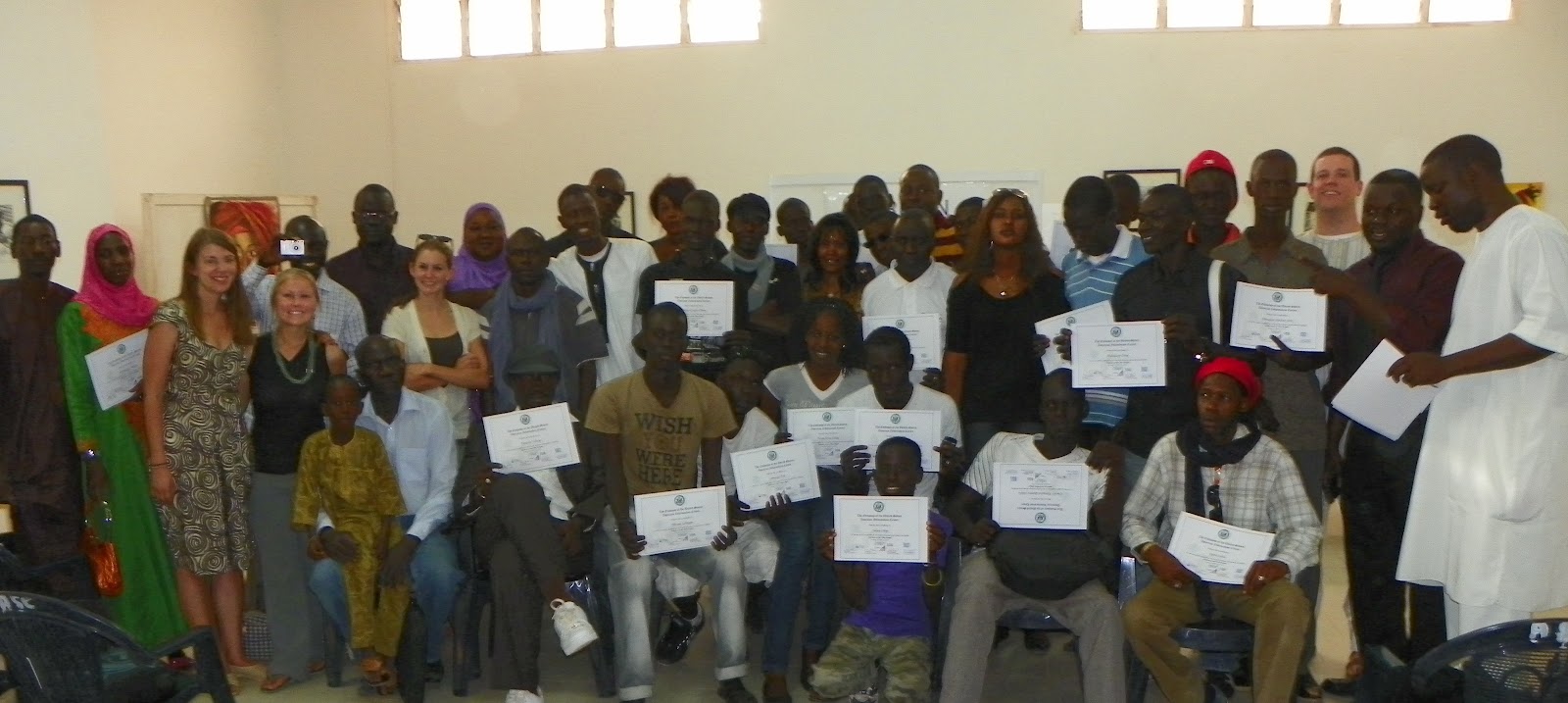
A highlight for all of us was the graduation ceremony.  There, we played super high-stakes review games, handed out certificates, and were usually treated to some sort of impromptu music performance.  Sometimes these festivities involved rapping, and sometimes they involved the director of the center breaking into the lost falsetto of his youth.  But always, they involved a potluck, the most American tradition of them all.  The concept took a little bit of explaining, but once everyone showed up with endless sugary drinks, peanuts, popcorn, mangoes, and beignets, they proved to have the idea down.  The graduation ceremonies gave our students an opportunity to make us pose for hours of camera phone photos with every single class member in every single possible group combination. 

One of our youngest students, who came to both sessions.  The first time around, his name was Sam, but during session two, he made the executive decision to call himself Obama.  Get it?  Executive decision? No but that really happened.


Ultimately, our little English class has become one of my favorite projects here, mostly because of how closely we get to work with all of our students.  As Colin said to me the other day, this class is one of the few places where we truly see a cross-section of Senegal, unlike the NGOs and universities where we do a lot of our city-based work.  I’ve loved chatting with all our participants, learning about their far-flung endeavors like filming documentaries and competing in debate competitions.  Plus, their generosity and gratefulness is astounding, and I’ve been sent emails, thank you letters, and dinner invitations far after class ended.  Senegalese people certainly know how to make a gal feel appreciated!

The session 1 class poses at the end of their commencement ceremony.

At the moment, we may face some changes as Colin, Rose, and Clare are all in the process of leaving Senegal, and I’m needing a break as my Plan project and Girls’ Camp have picked up.  But in a cool twist, the Cultural Center is considering hiring some of our best students to be assistant teachers and help some American lead teachers.  See what I mean?  Learning English can incite economic recovery!  At least for a few people.  We’ll see what happens.  Anyway!  So that concludes this session of Lisa describing how she fills some of her time, even though I know this blog often makes it sound like I’m just chasing monkeys or dancing to drum music with babies.

Friday, July 20, 2012

Becoming an Outdoor Girl


ADVENTURE!!!!!


I recently went on another adventure, which was a lovely little respite from the intense (but good!) work schedule I’ve committed myself to lately.  I’ll write about my work here sometime, I promise.  It’s just such a constant thing that I always feel like I can do it in the next entry.  So for today, TAMBACOUNDA-KEDOUGOU ADVENTURE!

Last year, I went to Kedougou for the 4th of July, and it was a rollicking good time.  Obviously, I wanted to return this year, not only to catch up with my far-flung friends again, but also to do a few things I missed last time, like hiking to the glorious waterfalls or doing something exciting, like sleeping in a tent.  I resolved to go to Kedougou and DO THOSE THINGS. 

On my way to DOING THOSE THINGS, I stopped by Maleme Niani, a roadside village in Tambacounda that my good friend Nicky calls home (NICKY'S BLOG HERE!).  While I live in a house with ten other people, Nicky lives with 80.  While my family doesn’t seem to care if I even say hi to them in the morning and often shuts my door for me, Nicky routinely talks to all 4,000 people in her village, and I’m pretty sure they all legitmately know her.  I realized how adapted I’ve become to my fancy city life when I found the level of social interaction required of her slightly overwhelming.

But on the plus side, I got to have a few memorable encounters.  For one, a handful of women on Nicky’s compound started fighting over whose husband would get me as a second wife.  We also got repeated, alternating confidence boosts and defeats as everyone, seeing two toubabs together to compare, would call one of us prettier than the other, but then follow that by saying the pretty one was pretty because she was so fat.  We were both pretty and fat during those two days.  I got a taste of village superstition when Nicky’s little siblings warned me in horror that “two crazy women are wandering around the village... they will ask you to hold their sheep... DO NOT DO IT! If you hold their sheep, YOU WILL DIE!”  It was just like a spam email, but it was real-life and delivered by Senegalese children!  And at night, Nicky’s room was invaded by rats the size of small dogs who, in a bizarre yet hospitable gesture, always poop in the same pile in the corner of her hut.

Nicky, on the left, was my host.  She has a great positive attitude despite living in a rat settlement and being friends with me.

Perhaps my favorite encounter came with one of Nicky’s most surly neighbors.  Upon arrival, the woman seemed to take a liking to me.  Through the course of conversation, she asked me, “Where’s my present?”, which is a typical (although occasional annoying) demand of any visitor or returning friend.  I tossed her the line I’d been using all day, which made most people laugh: “Present?  I’m your present!  Look at this face!  I’m a beautiful present!  And I’m your new friend!”  But this lady didn’t laugh.  She stared at me.  Then she told me that she hated my present.  I said, in the sassy way that usually makes a Senegalese person laugh, “Well, if you don’t like this present, it will leave Maleme Niani and never come back!”  The woman stared at me.  “Go then,” she said.  “Leave.  Leave my house.  I hate you.  I never want to see you again.  I hope you never come back.”  Nicky later told me that that woman has made her cry more than once.

In our effort to get to Kedougou, a city that lies roughly 4 hours southwest of Tambacounda, Nicky and I proceeded to make some of the worst travel decisions of our lives.  I still really do want to devote a blog to transportation in Senegal, and when I do that, this story will be explored in more detail.  But suffice to say, instead of being the first two people in a seven person 7-place, we decided to commit to the cheaper, 18-25 person car that seemed to only have four spots later.  Fast forward a bit – after sitting in the hot sun, being charged to pee, skipping lunch, and watching numerous 7-places happily head off to our destination, our car finally left 6 hours later.  It then promptly broke down about 15km outside of Tamba.  We reached our destination 8 hours later, which means our car averaged about 30km and hour for the 260km drive.  It was the kind of experience that people justify by saying, “Now you are so much stronger for it!”  No.  In no way did I ever need to know that I could survive on a Senegalese car from hell for 11 hours.  I was fine living without that knowledge.  It did not change my live at all.  I in no way needed that experience.

The impossible dream that fed our hope during the worst ride of our lives: KEDOUGOU.

But luckily, Nicky and I remained friends during it!  And then we made it down to beautiful Kedougou, where we had the privilege of...

  • -       Hiking numerous hours to waterfalls!  During this hike I got discover how outdoorsy my friends are and how prone I am to slipping on rocks and falling into creeks.  But I felt like I really used my whole body on this hike.  It felt human.
  • -       Camping in the great outdoors! I did it.  I slept in a tent, one night even by myself, which is a huge accomplishment given my past of being afraid of crickets in my room.  The downside of camping was that I spent about five days sleeping on damp clothes and blankets, and despite washing my stuff, all of my clothes still smell like mildew.
  • -       Stalked by monkeys! There were a few baboon fights in my midst.  A lot of my really progressive friends tried to have encounters with monkeys, which usually failed, but often resulted in a Jurassic Park-loaded silence that included all of the humans looking at each other and quietly whispering, “They’re watching us.”  And they were, from the trees.  And then we’d hear them run away from us.  Monkeys.  98.something percent human.  A + humans.
  • -       Seeing old friends!  Everyone who’s anyone was in Kedougou, and I got to see them all, and we ate pizza and danced in the rain and the mud and went swimming and it was GREAT.  In many ways, our lives imitated Rihanna’s “We Found Love” music video, especially the sparklers and mud part.  The soundtrack to our party had a lot of Hall and Oates and Robyn though, which meant I could never leave the dance floor.
  • -       Celebrating America! No one does the 4th of July better than a bunch of ragtag ex-pat hippies!  NO ONE.  And check out this picture of the girls in my stage.  SO PATRIOTIC.  So patriotic that this makes me feel like we’re in a DAR sorority.


Yeah girls.  Too bad we posed in front of a cornhole board that read "I love nuts on my face." (because the beanbags here are full of nuts... get it?)  Classy ladies.  Ignorant, classy ladies.
I returned home incredibly content.  It’s super fun to travel around Senegal, because I almost feel like I’m working while I’m on vacation, especially when I return to site and have the opportunity to enlighten my Senegalese friends and family about these crazy, wondrous parts of their country that they’ve never seen.  They tend to stereotype regions with one word, I guess not so differently than we do in America. Tamba – hot!  Kedougou – waterfall! Georgia – peaches!  Oregon – drugs!  But yeah.  Vacation success.  And until the next adventure, I will continue grappling with LIFE SKILLS, GIRLS CAMP, and transportation in Senegal.  

And here's a picture of Mohammad, because EVERYBODY LOVES A CUTE BABY

Sunday, June 24, 2012

My Favorite Week in Senegal


My favorite week in Senegal?  Easy: the week that I go to our Thies Girls' Camp.  Last year's camp was the best week of my service, and I fully anticipate this year's camp (September 9-14) to be the same if not better.  I’ve mentioned the Michele Sylvester Scholarship program a few times on this blog already, and thanks to everyone’s support, I think I’ve met my fundraising goals for that.  But there is still a way to contribute to that group of amazing girls: 


When I visited my scholarship winners over the past month, they were all grateful to hear that their school registration fees would be paid next year.  But they were all ECSTATIC to hear that they’d also be invited to their first-ever camp in September, which is the second thing they win when they're chosen.  These are all girls who spend their days cooking and cleaning to “make up for the fact that a family is letting them live in their house.”  The idea of having a fun week with other girls away from home kind of blows everything else out of the water.  Moreover, the Senegalese love camps - but few outside of a select group, typically those with money, ever have the chance to actually experience one.

Our camp is a mix of everything, dedicating different days to health, the environment, money management, and the FUTURE (their future, not the singularity).  Peace Corps volunteers lead sessions in our particular areas of expertise – I’ll be doing things like making spring rolls to talk about healthy eating and building hula hoops to emphasize the importance of exercise.  I'll also be helping with yoga, quietly, in the corner, just like last year.

  
Last year we surveyed the girls about yoga.  Almost all of them loved it.  One girl said that "cadaver pose" was her favorite activity from the entire camp... ha.

But our Senegalese friends and co-workers also facilitate a lot of activities.  For instance, we invite women to speak on a career panel about living and working in Senegal, and on another day, a local nurse comes in to answer their anonymously submitted health questions (it’s hard for them to know much about the body when science classes don’t even start until high school).  Ultimately, the girls learn a lot, but in true American education style, we make sure they have a lot of fun too: camp games, craft activities, variety shows, and movies are all part of the curriculum. 

Everyone responds to oatmeal masks in different ways, but dancing seems to bring out pretty universal emotions among Senegalese teenagers. 


But for me, the best part about camp is getting to know the girls.  It sounds crazy, but it’s hard to form good relationships with girls this age in everyday life, precisely for the reasons I’ve mentioned before: they are simply too busy, all the time.  It’s a Catch-22 – they’re the ones who need the most encouragement and support, the ones who constantly get the short end of the stick, but because they’re always sweeping, studying, cooking, or running around town doing errands, it’s hard to catch them for a minute and simply talk to them, get to know them.  

I'm especially excited to share camp with the girls I'll personally be inviting this year, aka my Michele Sylvester winners.  Almost all of them have lost at least one parent, and many are orphans living with extended family members... which, if you read the story of my "host sister" Fatamata, means that they miss out on a lot of perks and must work like crazy for their room and board.  Here's a little more about a few of them:


Mame

Mame is basically blind -- she has to read and do her homework with her face nearly pressed up against her books. She's that student who must always sit in the very, very, very front because her family can't afford the eye surgery she needs. But despite this, she was the most outgoing, excited, and talkative girls among my winners. She wants to be an engineer. 


Absa and Soda 

Absa and Soda are twins whose parents died within six months of each other in 2009. They have some of the best grades in the entire school and lofty ambitions: Absa wants to be a CEO and Soda wants to be a maternity nurse. Both girls have very strong opinions about the necessity of education in creating more powerful women in Senegal, but moreover, they are two of the humblest, loveliest, well-spoken teenagers I've ever met. When I visited their home, their great-aunt knelt down in front of me and thanked me for the opportunity I'm giving her nieces. 


Awa  

Awa is clearly one of the most popular girls in school, with good reason: she's quick, smart, and beautiful. But when I visited her home, it was obvious that she overcomes a lot each and every day... her family definitely struggles much more than others in the community, and they didn't seem very supportive of her achievements or plans. Awa told me she thinks all of the winners should start a girls' group after camp.


Khady 

Khady lives the farthest away of all the girls, making a 20 minute trek to and from school both in the morning and after lunch (the exercise wouldn't be so bad if it weren't 120 degrees a lot of days...). She is quick to help, has an endlessly positive outlook, and laughs at the drop of a hat. When I visited her family though, they made her work the whole time, and she didn't even get a chance to sit down with me. That was kind of depressing. 


Arame 

Arame confesses that her favorite pastime is reading, a hobby confirmed by her family: “Arame is always sitting with her books!” She lives on a huge compound of people, but seems especially close to her youngest cousin, who follows her around like a little duckling. Arame would like to be a lawyer someday, focusing on early marriage and the mistreatment of young girls by aunts and uncles. 


And, in a stroke of amazingness...


Fatamata 

Fatamata is the sister I wrote about in my previous blog post. I talked to my host mother, and after a little prodding, she'll get to attend our camp! There is absolutely no chance that the car will be too full to bring her at the last minute this time.


Here I am, sometime before I started making hats and eyeglasses out of paper last year during an art project.  If we're lucky, the past will recreate itself this September...


I hope all of you can help me in making this project a success.  It’s the LAST PROJECT I need funding for, so this is your last chance to work with me before I come back to AMERICA!  We’re hoping to get funded before July 31.  But without funding, the camp simply will not happen.  Which would be awful because I’ve already told the girls about it.  Not to guilt-trip anyone into donating.  But really, that would be awful.

I’ve seen firsthand how this camp can really enlighten and inspire these girls.  It’s only a week, but the girls keep in touch with each other, their counselors, and the Peace Corps volunteers long after camp ends.  One counselor has even used the knowledge he gained to start his own camp in his hometown.  All of these things make me really believe in this project.   

Please consider donating -- your money will be used to transport the girls, feed them, lodge them, and fund the weeks' activities, because other expenses, like paying our Senegalese counselors, have no fee -- they're volunteering for the week.  I've felt extremely fortunate for all of the support I've personally gotten over the past 15 months: emails, letters, packages, good thoughts, encouragement.  But here's your chance to help some other young ladies who need it more than me.  And if you can't personally help, maybe pass on the word to someone who can.


If you want more information about the camp, you can also check out the website we've put together here (http://campsenegirl.com).

Thanks for all of your time, support, and love :)


Love,
Lisa (and the other volunteers in my region and our future campers)


Thies Girls' Camp 2011